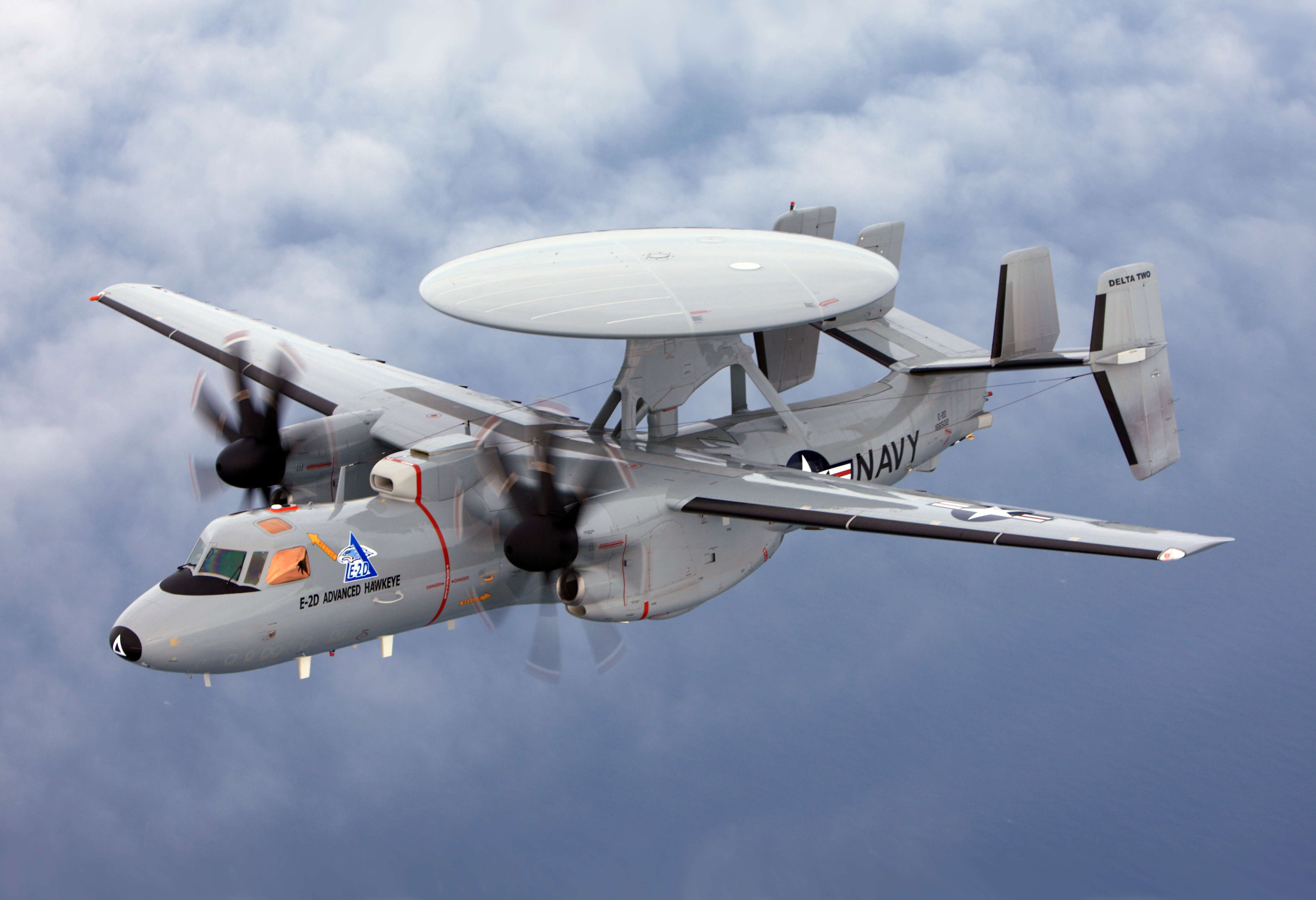
Aiding Ukraine Won’t Cause Nuclear War.

One of the reasons I have heard some people give for opposing continuing to support Ukraine in their fight for survival against Russia is that continuing to arm Ukraine will risk World War III. It’s unlikely that these arguments are being made in good faith, but I am going to assume the people using them have genuine concerns and are not just Putin’s puppets.

In my post about the F-16s going to Ukraine, I talked about why Russia wouldn’t respond to the decision to send F-16s with nukes. In summary…

TL;DR: “We will nuke you if…”
– Help Ukraine at all (Feb 2022)
– Send artillery (Apr 2022)
– Send HIMARS (Jun 2022)
– Send long-range missiles (Sept 2022)
– Send the Patriot System (Dec 2022)
– Send modern tanks (Feb 2023)
– Send F-16s (May 2023)

‘It’s Official: F-16s Are Going To Ukraine’ – Sam Becker, 31 May 2023

First, a couple caveats:

  1. I am a normal civilian who is interested in the aerospace, defense, and national security spaces. I don’t have access to any classified information.
  2. I have talked to people who were in the US defense apparatus (including a former nuclear and missile engineer for the US Air Force), but they didn’t share any classified information with me (despite my continued asking). I even checked out the War Thunder forums. All I found was leaked info on the M2 Bradley this time.
  3. Being an American, I will probably revert to referring to NATO/the west as ‘we’. Because ‘Murica.

Before we get in to this…

Before we get into the weeds, we need to talk about nuclear weapons themselves. There are 2 kinds of nuclear weapons- tactical and strategic.

Tactical Nuke

Tactical nuclear weapons are relatively small- they weigh between 1 kiloton and 100 kilotons and are meant for a limited battlefield use (the bombs that were dropped on Hiroshima and Nagasaki weighed about 15 kilotons). While they would cause immense destruction in their blast radius, they won’t turn an entire country into a less buggy version of the world of Fallout 76. When Putin keeps announcing that he is moving nuclear weapons to Belarus, these are the weapons he is talking about.

Strategic Nuke

Strategic nuclear weapons are what most people think about when they hear the term ‘nuclear weapon’- high-yield (up to 1,000 kiloton) nuclear warheads on long-range intercontinental ballistic missiles (ICBMs) designed to be launched in huge numbers at an enemy on the other side of the world and obliterate their entire country before they can strike back.

Nuclear Chain of Command

Just a quick note on who has command of the US and Russia’s nuclear arsenals. In the United States, we have 2 nuclear footballs- one that travels with the President at all times, and one that travels with the Vice President, and the Vice President can’t use theirs unless the President is incapacitated or otherwise unavailable. So effectively, only one person in the US can launch a nuclear strike. In Russia, it’s a three- the President (Vladimir Putin), The Minister of Defense (Sergei Shoigu), and the Chief of the General Staff (Valery Gerasimov). Any of those 3 people can launch nuclear weapons all on their own.
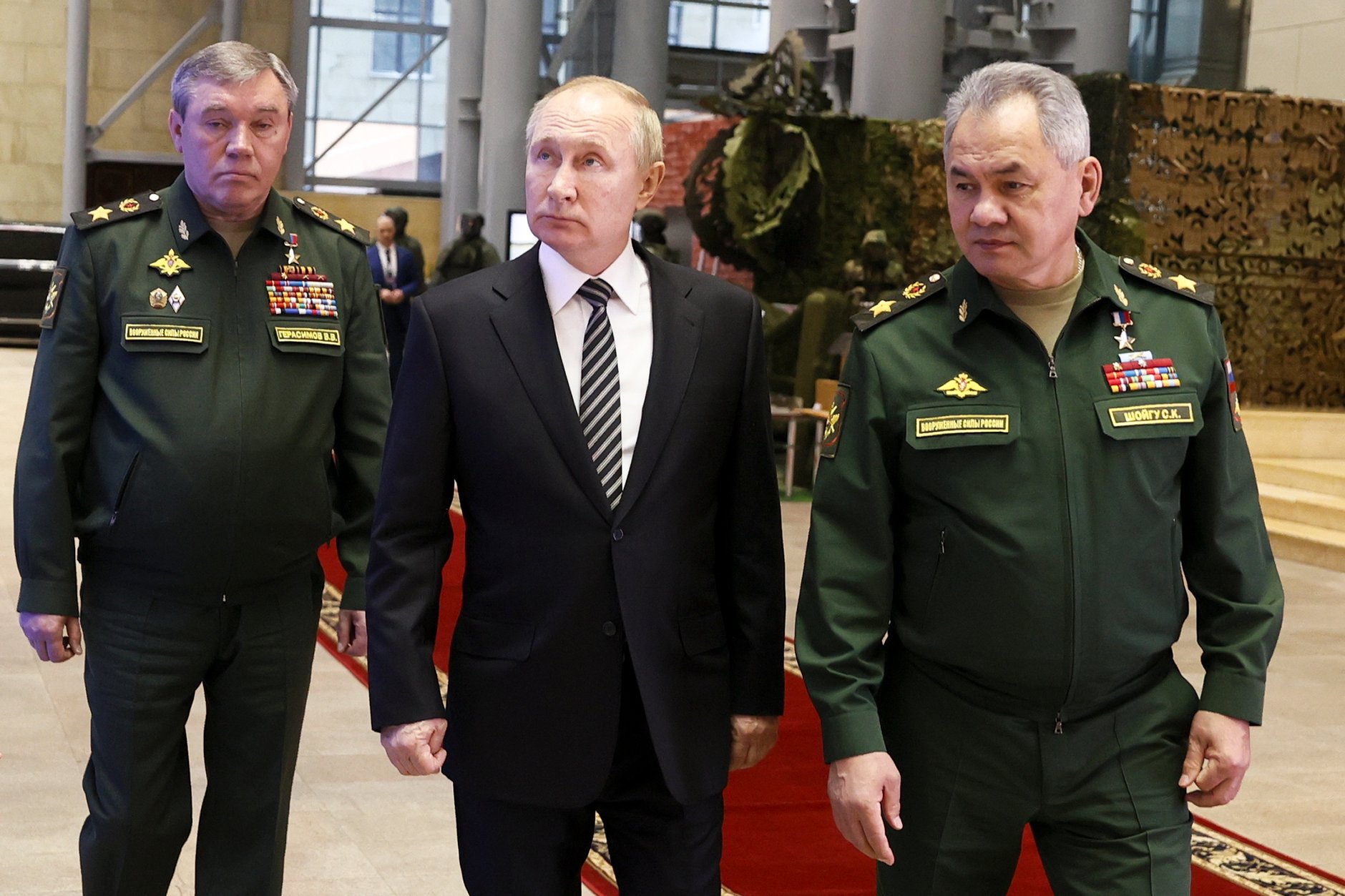
L to R: Valery Gerasimov, Vladimir Putin, Sergei Shoigu

So Why Won’t Russia Use Nuclear Weapons?

Does using nukes accomplish Russia’s Goal of ‘Winning’?

I’m not really sure what the goal of Putin’s war is anymore. The goalposts for a ‘victory’ change as often as the tides, but I think it’s safe to say that the overall goal is to force Ukraine to surrender some (or hopefully all) of their territory, make the west cut off all support, prevent Ukraine from joining NATO, and keep himself and his cronies alive and in power back home.

With those ‘goals’ outlined, let’s take a look at this map of Europe. Where does Russia strike to achieve those goals? Kyiv? Odessa? Ramstein Air Base in Germany? Warsaw? Ankara? Brussels? The more you think about it, the less sense it makes.

Let’s work out a hypothetical. Say Russia attacks a battalion of Ukrainian troops that are advancing on the Zaporizhzhia front as part of a future counteroffensive with a tactical nuclear weapon. The troops are killed, their equipment is destroyed, and the advance stops.

So what happens? Let’s go point by point of Russia’s goals and see which of them are get achieved.

  1. Will Ukraine surrender if Russia uses a nuclear weapon? No. All the evidence from this war so far has shown that battlefield atrocities committed by the Russian Armed Forces have been met will even stronger Ukrainian resolve. The use of a nuclear weapon is unlikely to have a different result.
  2. Will the west cut off support from Ukraine? No. The west has a strong interest in ‘maintaining the nuclear taboo’ (more on that below). Think of it like a hostage situation. The US government doesn’t negotiate with hostage takers because it incentives the further taking of hostages. If the rest of the world sees that using a nuclear weapon is a ticket to get what you want, everyone will use them (think North Korea reunifying the Korean Peninsula, China reclaiming Taiwan, or Israel and Iran just because they’re always looking for a reason to attack one another or do the occasional deep penetration strike on some nuclear reactors).
  3. Will it prevent Ukraine from moving forward with NATO membership? No. (See above)
  4. Will it keep Putin in power back in Russia? Unknown. See the end of this post for more on Putin’s future if he uses a nuclear weapon.

Response from Allies

Russia’s most important allies are China and India (No offense to the rest of BRICS (Brazil, Russia, India, China, and South Africa) but the ‘I’ and ‘C’ do kind of carry that alliance). They are keeping Russia’s economy afloat by buying large amounts of energy (and getting a killer deal by robbing Russia blind, too).

Xi Jinping (also known as Winnie the Pooh) has already warned Russia to not use nuclear weapons in Ukraine. Narendra Modi (also known as Narendra Modi- he doesn’t have a derogatory/humorous nickname that I could find) hasn’t made any public statements or warnings yet, but if Indian or China continue to do ‘business as usual’ with Russia after the use of a nuclear weapon, they would open themselves up to sanctions by the rest of the world.

Response from NATO

NATO will have to respond militarily to the use of a nuclear weapon. I think a lot of people imagine that we would use a nuclear weapon in response, but I’d argue that we wouldn’t even need to. NATO has the conventional military power to retaliate against Russia without escalating to using a nuclear weapon of our own. Here’s what I think would probably happen if Russia uses a nuclear weapon:

  • Destruction of Russian forces in:
    • The internationally recognized borders of Ukraine
    • Occupied territory of Transnistria in Moldova
    • Occupied territories of Abkhazia and South Ossetia in Georgia
    • Syria, including their fancy naval base at Tartus on the Mediterranean Sea
  • Sinking of what’s left of the Black Sea Fleet (although at this point, Ukraine might have this one wrapped up for us already)
  • Establishment of a no-fly zone over Ukraine
  • Complete blockade of Russian ports and airspace

Putin’s Future

Earlier, I talked about Putin, Shoigu, and Gerasimov having the ability to launch nuclear weapons in Russia. If Putin is going around slinging nuclear weapons around Europe, there’s very little reason for the CIA or other world intelligence agencies to, umm, bring about regime change in Russia as a whole or at least at the Ministry of Defense. Putin and co. will have to pick their favorite bunker and never leave out of fear of meeting a hellfire missile from a Predator Drone overhead.

(bonus) Their nukes might not actually work

This is kind of a bonus one and is totally speculative. Given how the rest of Russia’s military equipment has performed in Ukraine, there’s no guarantee that their nuclear weapons will actually work as they’re supposed to.

We need to look at some numbers. Check out this chart and I’ll summarize it below.

CountryTotal Defense BudgetNuclear Arsenal Budget% of Budget
USA$740 billion$43.7 billion16.93%
Russia$75 billion$9.6 billion7.81%
US vs. Russian Defense and Nuclear Spending- FY2022

Russia’s 2022 defense budget was 4.9 trillion rubles (approx. $83.5 billion USD at the time). Russia’s ICBMs are liquid fueled. The US’s ICBMs are solid fueled. Liquid-fueled rockets are much harder to keep in working order than solid-fueled rockets are. So they have more rockets that are far less reliable than ours and spend less money than we do. Obviously, the stakes are way too high to find out, but it’s something fun to think about.

Slava Ukraini, and fuck Russia and all its enablers in the United States and around the world.

Ukraine Shot Down Another Important Russian Plane

I know I’m a week late, but it was stated last Friday that the Ukrainian Air Force successfully shot down a second Beriev A-50 ‘Mainstay’ Airborne Warning and Control System (AWACS), the latest in a long string of aircraft losses in their 3-day special military operation in Ukraine.

Disclaimer: I’ve been working on this post for a week, but Ukraine won’t stop shooting down Russian fighter jets long enough for me to post it. As a matter of fact, they shot down another Su-34 as I was finishing up this post.

Beriev A-50U ‘Red-41’, in service with the Russian VKS

What is an AWACS?

In short, an Airborne Warning and Control System (AWACS) is a special plane with a big a** radar dome stuck on the top. They’re mounted on big airplanes like the Boeing E-3 Sentry (based on the old Boeing 707). Their radar monitors the airspace in a large area (hundreds of miles) for friendly and enemy aircraft, cruise missiles, and pretty much anything else in the sky (including birds).

How Did Ukraine Shoot It Down?

At first, I figured this shootdown was the work of the mysterious roaming Patriot battery near the front lines that keeps downing Russian jets, but it is reported that it was actually an ancient Soviet S200 SAM system. I’m totally speculating here, but here’s what I think happened:

Ukraine strikes air defense radar installations along and near the frontlines. In order to try to maintain their aviation operations, the Russians call their A-50 forward to augment the radar coverage. Ukraine then takes the opportunity to take out the A-50.

If this is actually accurate, it poses the question: what will Russia do next? Will they bring another A-50 to the front lines and risk losing another one? I guess only time will tell.

Why Is This Shootdown So Important?

In short, this is a really special airplane. Russia had 9 in pre-war service. Now they have 7, assuming all 9 were originally operational. To put that in perspective, the US Air Force has 31 E-3 Sentry AWACS in its fleet (with NATO having an additional 17), and the Navy has 55 of the smaller carrier-based E-2 Hawkeye AWACS. (Not to mention the incoming E-7 Wedgetails).

The A-50 is based on the Ilyushin Il-96 strategic airlifter. The Il-96 is still being manufactured, but it is unclear if the A-50 is still being made. If not, it’s unlikely that production lines could be started in time to replace these losses. So unless India will sell them one of theirs, they might just be out of luck.

Nuclear War

I’m working on a post about the risks of Russia using nuclear weapons in Ukraine, and why they won’t. Hopefully I’ll have that done soon.

pexels-photo-15115064.jpeg

It’s Official: F-16s Are Going To Ukraine!

The Headlines Are In:

The US says it will allow its Western allies to supply Ukraine with advanced fighter jets, including American-made F-16s, in a major boost for Kyiv.

Jonathan Beale, BBC

America and its allies plan to provide F-16s to Ukraine — although the fighter jets may not necessarily come directly from the United States — as part of a long-term effort to strengthen the country’s security, a senior Biden administration official said Friday.

Peter Alexander and Rose Horowitch, NBC News

Over the next few weeks, the US and partner nations will launch a joint training program in Europe in which Ukrainian pilots will learn how to operate fourth-generation fighter jets, like the US-made F-16, a senior Biden administration official told Breaking Defense.

Ashley Roque, Breaking Defense

So that means the war is over and Ukraine is going to run a ‘reverse Desert Storm’ air campaign and drive out the Russians, right?

Hopefully you could detect the sarcasm through text in that previous paragraph. No, this isn’t going to end the war. No, Ukraine isn’t going to become the US Air Force. But they can definitely make a big difference. How? Let’s talk about it.

NOTE:
I have some TL;DRs (Too long; didn’t read) if you want to skip some of my nerd spiraling. They’re in these blue boxes.

Back to the Soviet Union

I’ll try to not get too far down the historical rabbit hole here, but any discussion of eastern air strategy has to start with the Soviet Union. Knowing that they were outmatched by NATO in the air, the Soviets decided to invest heavily in developing Ground-Based Air Defense (GBAD) systems. The Soviet Union (and now Russia) has always been the king of the air defense market. They are one of the few countries who can supply a full-service Integrated Air Defense System (IADS)- S-300 and S-400 for strategic and long-range targets, mobile BUKs, Tors, and Pantsirs for short and medium-range targets, and Strela MANPADS (Manned Portable Air Defense Systems) to be carried by light infantry. The S-300 and S-400 are considered to be some of the most potent air defense systems in the world. NATO countries (*cough*Turkey*cough*) have taken delivery of S-400 systems even though that decision resulted in its being kicked out of the F-35 JSF (joint strike fighter) program.

None of the focus on GBAD is to say that the USSR didn’t have a large air force. It did. At the time of the Soviet Union’s collapse, they had more airframes in service than the United States Air Force currently does. Big, however, does not equal effective in every combat environment. The Soviet Air Force was not designed to be an equal to the United States Strategic Air Command (SAC). It consisted heavily of long-range strategic bombers intended for nuclear strike missions, and in naval aviation using long-range cruise missiles designed to sink NATO aircraft carriers.

When the USSR broke up, Russia got to keep a majority of the Soviet pilots, but not aircraft- the aircraft were distributed across the multiple former Soviet republics. Yes, Russia did negotiate the purchase or return of many aircraft back to Russia, but the air force available to them was still designed to start and then survive a nuclear apocalypse, not win dogfights or provide close battlefield support.

I could talk about the cash infusion of the early 2000s or the reorganization to the current VKS (Vozdushno-kosmicheskiye sily) in 2015, but that’s not what this post is meant to be about.

Modern Air Doctrine

Anyone who has seen Top Gun might think that all fighter jets do is dogfight other fighter jets in dramatic close-range combat using their cannons. The reality is that this is almost never the case. Almost all of modern air-to-air kills have been done beyond visual range (BVR) with guided missiles, or are attacks on ground targets with air-to-ground missiles and guided bombs. So yeah, a realistic Top Gun would be pretty dang boring.

Air Superiority/Supremacy (And why no one has achieved it yet)

What are Air Superiority and Air Supremacy?

Well, they are what they sound like- ruling the airspace above a combat zone.

The official definitions according to the U.S. Department of Defense are:

  • Air Supremacy: “degree of air superiority wherein the opposing air force is incapable of effective interference.”
  • Air Superiority: “degree of dominance in [an] air battle … that permits the conduct of operations by [one side] and its related land, sea and air forces at a given time and place without prohibitive interference by opposing air forces.”

Operation Desert Storm

Famously, during Desert Storm, the US and coalition forces quickly commanded air near-total superiority over Iraq with a large cruise missile and air campaign- Hellfire missiles and 70mm rockets launched from AH-64 Apaches on key radar installations, Tomahawk cruise missiles launched from the USS Missouri and USS Wisconsin, F-117 Nighthawk stealth bombers dropping Paveway laser-guided bombs on Baghdad, AGM-86 cruise missiles launched from B-52s at power plants and communications sites, air defenses struck by F-4G Wild Weasels, US Navy A-6 Intruders launching decoy glider drones toward Baghdad, lighting up the radars for US Navy F/A-18 Hornets armed with High-speed Anti-Radiation Missiles (HARMS) to destroy, and ground targets and airfields struck by many other fighter aircraft, and a whole lot more.

I could go on and on about the masterpiece that is the Desert Storm air campaign, but I’m here to talk about Ukraine.

How to Achieve Air Superiority

One big component of achieving air superiority is Suppression of Enemy Air Defense (SEAD) missions. SEAD missions are interesting because their objective is for aircraft to find and destroy the things whose very purpose is to find and destroy them. They are also a huge part of any air supremacy campaign. They require specially-trained pilots in special aircraft, and even then are still incredibly dangerous.

The other big component is pretty simple- destroy all the enemy’s aircraft. They will have a hard time contesting their airspace without any aircraft with which to fly.

A lot of people in the west (myself included) thought that Russia would launch their invasion with an air campaign similar to Desert Storm or Iraq II’s ‘shock and awe.’ And sure, Russia did launch their own air campaign. But instead of radar installations and communications centers, their cruise missile targets seemed to be random airports and empty fields. Their SEAD missions were flown by untrained pilots in unsuitable aircraft, rendering them ineffective.

In fairness to Russia, the lack of accurate targeting could come down to the FSB’s faulty intelligence reports.

So why hasn’t either side achieved air superiority?

It’s an interesting result of both countries having been one country relatively recently. The Soviet Union’s focus on air defense has determined both sides doctrine. Ukraine has a very potent air defense network that Russia failed to destroy during their opening assault. Russia’s air forces are still largely ineffective, only launching standoff munitions from far behind their own frontlines.

On the other side, Ukraine doesn’t have the air force to achieve their own air superiority. Their GBAD network and small fleet of fighters can keep the airspace contested, but aren’t enough to achieve superiority.

TL;DR:
Air superiority is controlling the airspace above a combat zone. Neither side has achieved it because the Russian VKS sucks and Ukraine’s air defense doesn’t.

Ukraine’s Air Force

The Ukrainian Air Force’s fleet is currently comprised of Soviet-built aircraft produced before the collapse of the Soviet Union in 1991.

The current fleet of combat aircraft is:

AircraftType/RoleNumber in ServiceClose NATO Equivalent
MiG-29Multirole51F-16 & Eurofighter Typhoon
Sukhoi Su-24Ground attack12F-111 & Mirage IV
Sukhoi Su-25Ground attack/CAS16A-10 Warthog
Sukhoi Su-27Multirole32F-15

The F-16 and its capabilities

pexels-photo-15115064.jpeg
Photo by Omar Barrera on Pexels.com

The F-16 ‘Fighting Falcon’ (also commonly called the ‘Viper’) is a multirole and air superiority fighter built by General Dynamics (now Lockheed Martin) starting in 1974. It has a top speed of Mach 1.7+ (1,319 mph, depending on configuration) with a service ceiling of 50,000+ feet. For armaments, the F-16 has an integrated M-61A1 20mm multibarrel cannon and 11 external hardpoints allowing it to carry a variety of weapons including air-to-air missiles like the AIM-9X Sidewinder or AIM-120 AMRAAM, air-to-ground missiles such as the AGM-88 HARM, anti-ship missiles like the AGM-84 Harpoon, several types of bombs including the GBU-27 Paveway III, and even B61 and B83 tactical nuclear weapons (and no, we aren’t going to give tactical nukes to Ukraine). The hardpoints can also carry external fuel tanks to expand the stock 7,000 lb fuel capacity to 12,000 lbs.

TL;DR:
It’s a very capable and flexible platform. Please excuse my nerding out.

Why does Ukraine want F-16s?

The answer to this question might seem obvious at first- American fighter jets good, Russian fighter jets bad or broken. But it isn’t that simple.

Several members of the Ukrainian parliament said that they wanted F-16s because of their powerful radars that can locate ground targets up to 500 miles away. This is far beyond the capabilities of the existing Ukrainian Air Force.

The planes can also play a part of Ukraine’s air defense network- shooting down missiles, drones, and aircraft, saving Patriot or S-300 surface to air missiles (SAMs).

The F-16 can also provide close air support for ground troops. The term close air support is frequently used with the venerable A-10 Warthog or the AH-64 Apache, but the F-16 is also capable of providing precision close air support. This ability can play a large role in future Ukrainian offensives.

Another offensive capability is providing deep fires- striking targets deep within Russian occupied territory without leaving safe Ukrainian airspace. This allows Ukraine to strike Russian command and control posts, supply depots, logistic bases, and other military targets as far away as occupied Crimea and the Black Sea.

How Will Russia Respond?

They’ll nuke us, obviously. I mean, they put their nuclear forces on ‘high combat alert’ (the equivalent of the US raising their DEFCON) on February 27th 2022, 3 days after the invasion started. And they threatened to nuke in April of 2022 if they provided weapons to Ukraine. And again in June 2022 after the arrival of the US M777 Howitzers and the announcement of HIMARS. In September, Russia threatened the west with retaliation if they provided longer-range missiles to Ukraine (US ATACMS, British Storm Shadows, etc), saying that they would be a ‘party to conflict.’ They again warned of ‘consequences’ in December 2022 if the US sends Patriot Missiles. In February 2023, Putin warned the west about sending modern tanks. And that brings us to today. Clearly, the entire western world is a nuclear wasteland, right? Because the west provided all of those things to Ukraine. (In fairness, the US never provided ATACMS, but the British provided Storm Shadows and the French provided SCALPs).

TL;DR: “We will nuke you if…”
– Help Ukraine at all (Feb 2022)
– Send artillery (Apr 2022)
– Send HIMARS (Jun 2022)
– Send long-range missiles (Sept 2022)
– Send the Patriot System (Dec 2022)
– Send modern tanks (Feb 2023)
– Send F-16s (May 2023)

Again, hopefully you picked up on the sarcasm. Russia didn’t use nuclear weapons against the west despite our crossing all of their ‘red lines.’ And I’m confident that they won’t. If people are interested, I can make a whole post about why I don’t think Putin will use nuclear weapons. If you want my thoughts on that, leave a comment on this post or check out my Contact Page.

Will F-16s Make a Difference?

Definitely. The exact way Ukraine with utilize them is still unknown, but their capabilities and the Ukrainians’ ability and motivation to quickly learn new advanced western weapons systems leaves little doubt in my mind that the F-16 will be put to good use.

The End?

This post was way longer than I thought it would be. Thanks for sticking around and making it this far; it means a lot to me. I’d love to hear your thoughts and questions. Check out my Contact Page for my Twitter and email or comment on this post; I’d love to talk with you.